Thursday, August 21, 2014

Painted Pigs Honoring the Minnesota State Fair

Painted Pigs for the State Fair
Spotted Pig
3D Pig
Salted Pig
With no animal husbandry in my family, my entry into the Swine category in the Minnesota State Fair would have to be painted. You won't find them at the Fair, though, as they were completed much too late (yesterday) to be proper entries in any category.

These and other tiny original painted pigs will be available at the Hopkins Farmers' Market (Saturday August 23 from 7:30-noon), and at the Art Shoppe at Midtown Global Market beginning Monday August 25.

They all different. Each is matted and ready-to-frame in a 5x7 frame, and packaged with an envelope in a Clearbag. $15/each.

The J.V. Bailey House Pig
If you want to see a cousin of these pigs, stop by the J.V. Bailey House, home of the Minnesota State Fair Foundation.  While you're there, become a Friend of the Fair.

Tuesday, August 19, 2014

Cave Painting Progress: Cat faces

I am an unabashed cat lover, having been managed by cats since 1972. Fitting, then, to honor cats in the Lost Cave Paintings of Saint Paul Installation for the WARM Mentor-Protege Show.

Russian Blue Ancestor

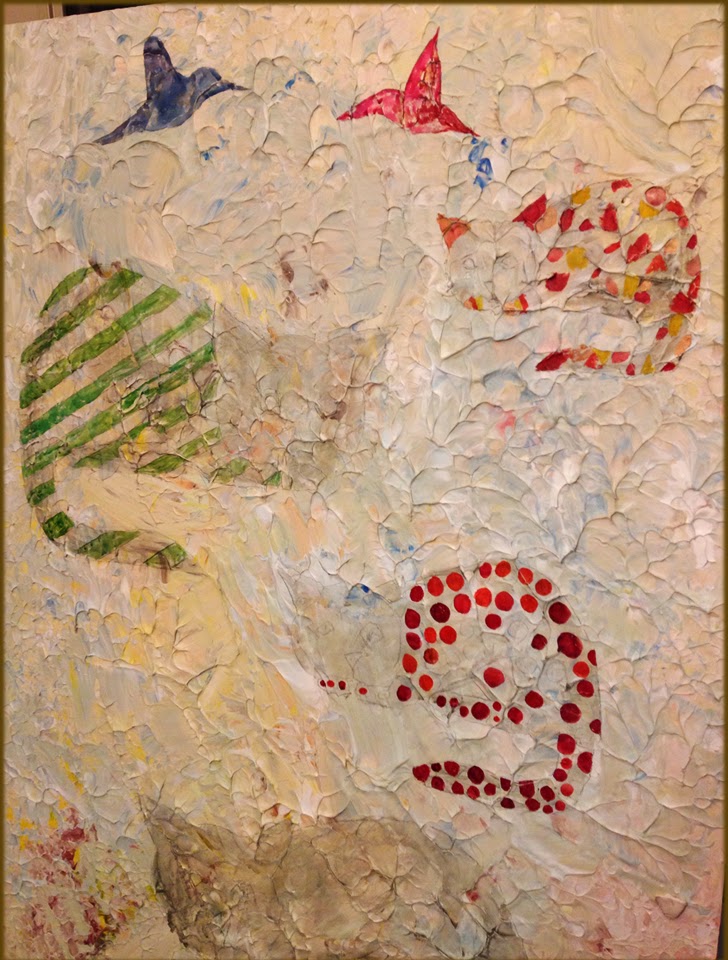
The Cat Panel

August 19 work-in-progress
The Cat Panel documents some of the ancestors of present-day Saint Paul Cats, including the Russian Blue and Striped Cats.

Digging through my shapes-and-templates archive, I found a cat that I had used for a needlepoint piece, and for two of my very earliest cat paintings. What better cat to honor the Ancestors?

Friends of the Cats

Like all of the panels, this one has both hummingbirds and frogs.


First Face

What about the faces?

Rendering the faces is the next challenge, and I can't do too much navel-gazing about it. Unlike the  Great Cave Owl, who sat on my easel for six months while I practiced painting owl faces, this piece is for a show that opens in a few weeks.  (Join us for the Celebration on Saturday October 18 from 6 to 9 at the Grain Belt Bottling House.)

A piggish experiment.

One thought is to make the faces even more 3D than the "cave gesso" provides. This pig is my first experiment. Using Golden Brand Light Molding Paste, is an interesting idea, but I am a 2-D artist who has always thought that sculpture was an inaccessible magical skill.
A molded pig

Thursday, August 14, 2014

WARM Cave Painting Update: The Elephant

The WARM (Women's Art Resources of Minnesota) Mentor-Protege Show is coming in October, and, having had two years to conceive and to work on this piece, a progress report is in order.

Materials review  This project consists of five 5x2' primed aluminum panels covered with tinted gesso to create cave texture.The Elephant panel is the last of the five panels to get paint. Last night, I mixed a gray from acrylic colors (black, white, gray, and silver) and some Golden Self-Leveling Clear Gel. Miraculously, I have leftover paint. 

Your eyes do not deceive you. The Elephant's ear is, indeed, purple. To some leftover Elephant Gray, I added a purple acrylic and Golden Granular Gel Medium.

Making the drawing My original plan was to scan my tiny elephant painting into Photoshop, scale it up, and print each segment to make a 5-foot template. Much tape would have been needed to create the template. I am grateful to my friend, the elegant artist Jason Najarak, for showing me how to use a projector to get the image onto the panel.

The Elephant Drawing

The Painted Elephant


The other panels (owls, parrots, cats, and toucans) are in-progress.

Show notes: The show, Beyond the Surface, will run from October 3 to 31 at the Grain Belt  Bottling House, 79 13th Avenue NE, Minneapolis, MN  55413. The opening reception is October 18, and there will be artists' talks on October 9, 11, and 30.  The schedule and more details TBA.

Sunday, July 27, 2014

The Cats: A cave painting breakthrough:

The WARM Show

The WARM (Women's Art Resources of Minnesota) Mentor-Protege Show is coming in October, but the catalog picture and info deadline is August 1. Hence, the race to produce something that either sensibly represents "work-in-progress," or approximates "finished."


Three of the Five Panels

Cats, Parrots, and Owls in Progress
The Lost Cave Paintings of Saint Paul piece will have five panels: Owls, Parrots, Cats, Some Random Birds, and an Elephant. (It's my cave, so I can populate it at will.)

The Owl and Parrot Panels are not quite finished, but the images are all recognizable owls, parrots, and the border hummingbirds (top), and frogs (bottom.)

Cave Cats In Progress

The Cat Conundrum

In life, I answer to two cats, so it would have been impossible to keep cats from the cave walls. But what image(s) to use?

 If you know my work, you'll recall dozens of cats of all shapes and sizes.  I searched my image file and found one that I had used on two of my earliest paintings, Dot Cat and Striped Cat. I made three different sized templates, and "ghosted" them onto the panel with one of the most useful of watercolors, Winsor Newton Davy's Gray.

An organizing principle? A theoretical construct? A plan!

Because the Lost Cave Paintings of Saint Paul are whimsical historical documents, it seems reasonable that the Cat Panel would depict some of our current cats' ancestors. Who is to say that the Great-great-great-great-great-great-great (etc.) Grandpa of an orange-striped tabby didn't have a green stripe?

Other Markings' Research:  

The Small Friends' Research Institute, (sponsor of the bulk of my research into whimsical creatures and publisher of The Small Friends' Chronicles and Meet the LLLamas) tasked its entire staff with emergency research into the markings on Ancient Cats of Minnesota. I expect a report this afternoon.

Related posts, retail outlets, and a web link

Lost Cave Paintings Progress: On to the next level
Lost Cave Paintings of Saint Paul: for the WARM Mentor-Protege Show

Cave paintings are available at The Art Shoppe at Midtown Global Market (Minneapolis) and at Three Sisters' Eclectic Arts (Saint Paul), and from my website.

Monday, July 21, 2014

Lost Cave Paintings' Progress: onto the next level

WORK ON THE CAVE CONTINUES

Now a work-in-progress at another level, the Cave Paintings have owls, parrots, frogs, and hummingbirds sketched on two of the boards.

I used traditional watercolors and two big synthetic brushes for this stage. I respect my Kolinsky Sable brushes too much to use them on top of gesso. As between a natural brush and acrylic gesso, the brushes die.

LOOMING DEADLINE

An August 1 deadline for the WARM Mentor-Protege Show catalog photo is looming, so I'll be burning the midnight oil...

The show, Beyond the Surface, will be at the Grain Belt Bottling House, 79 13th Avenue NE, Minneapolis, MN  55413 from October 3 - 31. The opening reception is Saturday October 18 from 6 to 9 p.m.  Ya'll come. 


Parrots and Owls Sketched, July 21, 2014.

Related post: Lost Cave Paintings of Saint Paul for the WARM Mentor-Protege Show (July 14).

Monday, July 14, 2014

Lost Cave Paintings of Saint Paul for the WARM Mentor-Protege Show


Women's Art Resources of Minnesota (WARM)'s Mentor-Protege Show is fast approaching. I have plotted and planned for months, and finally have taken gesso in hand to begin.

The Plan

THE PROJECT 

The project will be an installation of an excavation of some of the Lost Cave Paintings of Saint Paul. I began making these paintings in 2012 after watching Paul Boecher demonstrate using gesso* on board at the Northstar Water Media Society's Art-on-a-Line. A piece of his gesso-on-paper looked like fresco, and my mind went immediately to "cave wall."

Since mid-2012, I've made more than 150 large and small cave paintings, and dozens of "friends of the cave" Pandas who inhabit the Hidden Bamboo Forest of Saint Paul.

* A Word About Gesso: In the modern era, gesso is an acrylic medium as thick as Greek yogurt that artists use to make surfaces either smooth or bumpy. I make textured cave walls with white gesso that I tint with watercolors for small works or acrylic paints for large ones. Historic gesso was made with rabbit skin glue and minerals. I am glad to be a 21st century artist who can skip boiling rabbits and simply buy gesso at Wet Paint or at Dick Blick.


The Flamingo's Last Outing:
Northern Spark at the Vine Arts Center

MEET THE FLAMINGO 

This 5-foot flamingo has lived in my downstairs bathroom for more than 15 years. I took the paper design to a lumber yard where the staff kindly (without laughing) cut out the bird, made a dozen sets of book ends, and 20 8-inch rounds from the plywood that I purchased.

Flamingo with Magenta-
Tinted Gesso
In the original plan for the bird, I would have covered the body with beads, mosaic-tiled the legs, and created a stained-glass-shard-mosaic for the grass and weeds. Fortunately, it was a flexible plan, and I was very happy with some-beads-and-paint. All of the other flamingo pieces in the bathroom miss their Big Birdy Buddy.

The flamingo's body is now covered with tinted pink gesso, and the weeds are covered with weed-colored-and-textured gesso.


THE CAVE WALLS 


The five aluminum boards (cut and primed with great skill by Jason Najarak), are now a taupe/gray that is a mixture of white gesso and an astonishing amount of acrylic paint. I used sepia, chrome yellow, chrome orange, phalo blue, violet, metallic bronze and gold, venetian red and probably a few more. Each panel is slightly different from the others.

NEXT STEPS

1. Create the templates for the creatures. I have gone into my archive for my favorite images. The original elephant works well on a 5"x7" tiny painting. Making him into a 20"x40"paper template will use all of my cut and paste skills.

2. Paint the creatures, including the dozens of frogs and hummingbirds which will be part of the continuity for the panels.

3. Print and install the maps for the back of the piece. Because this will be free-standing in the middle of the room, it can't have an unsightly "naked" back. I will cover it with maps of Old Saint Paul made from electronic files from the the Ramsey County Historical Society Library in the basement of the Landmark Center in downtown Saint Paul.

4.  Print the "Visit Very Old Saint Paul" postcards for the postcard rack.


Monday, April 21, 2014

14 Rules for Consigning Your Art

Cousin Charlie Rooster #2
is a greeting card on
consignment at
Once you have decided to share your art beyond giving it as gifts to friends and family, you will look for venues to sell your work. Art sales options can be overwhelming: ETSY (your work), zazzle (your designs on their products), your own blog, any of the dozens of web-based group sales venues, art fairs, sales through the arts organizations that you have joined, and farmers' markets. 

Considering consignment

Eventually you may consider consignment, a nifty arrangement in which you put your work into either a brick-and-mortar or web-based store in which someone else handles the customer interactions (conversations and sales), and you keep ownership of the work until it sells. The benefits are wider exposure than you might create on your own and the expansion of your sales team to include the store owners and staff. For this, you pay a percentage of the sales price.

Consignment is a big step. Think through these points as you consider consignment:

1. Find the right venue #1. 

Talk to the owners or managers. They are in business to make money for themselves and for their artists. Make sure that you are comfortable with the people you will trust with your art.


Pandas from the 
Hidden Bamboo Forest of Saint Paul
are on consignment on a greeting card at 
2. Find the right venue #2.  

If a store has a mission (representing artists from under-served communities, artists with disabilities, artists from a specific geographic area), don’t press to be accepted if you are not a member of the group.  

3. Find the right venue #3.

Pay attention to stores’ price points. Don’t embarrass yourself by approaching a high-end-big-dollar gallery if the work that you want to sell is exactly what you sell on ETSY for under $30.

4. Find the right venue #4. 

Style matters. A gallery with a 20-year history of selling cutting-edge abstracts run by one of the Big Names in Abstract Art Criticism may not be interested in taking on even the most exquisite realistic botanical art. 

5. Find the right venue #5. 

Some stores require artists’ participation beyond dropping off work. Is there an hours-per-month requirement? If you are uncomfortable with a few hours a month at retail, are there other ways to fulfill a work requirement? Ask about the managers’ needs. Consider social media, marketing and merchandizing as ways to fulfill your obligation.

6. Follow the store’s protocols with your Inventory Integrity.  

You want to sell your art, and all stores have rules about pricing and presentation which -- if you want to get paid correctly --  you must follow to the letter. Although you will not be in the store every day, you must monitor your own inventory. Once accepted, you will submit inventory sheets with coding, prices, and product descriptions. Smart artists use consistent inventory coding and pricing across all inventory and across all platforms. Present legible inventory lists. Unless it is the policy, don’t expect the store managers to code and price your work.

7. Understand when and how you will be paid. 

Some stores have multiple levels for consignors. Make sure that you understand exactly how each store's compensation system works. Most stores collect and pay sales tax. You are responsible for paying your own income tax. Talk to an accountant or tax lawyer to make sure that you are tracking your sales and paying your income taxes correctly.

8. Setting prices #1. Pricing is hard. 

What is the magic number that will encourage someone to purchase your work without undercutting its value (and your profit)? How much is too much? How little is too little? Talk to the managers. Look at the stock and ask about price points and what sells best. Talk to your artist friends who sell on consignment, and ask for their advice.

9. Setting prices #2. 

Price your items consistently. If not now, then soon, you will be selling art in many outlets and across many platforms. Nothing will irritate store managers and customers more than inconsistent pricing should you have one price for your website, another price for ETSY, one price for this store, another for the shop across town, and yet another for your direct sales. This is part of your Inventory Integrity, and only you can manage it.

10. Packaging: People buy with their eyes

Always present clean, well-packaged work. Make sure that price tags and other tags are legible.

11. Ask to do a demo or to teach a class. 

Many consignment venues have space for teaching which generates traffic for the store and can generate income for you. Note that store owners and managers are your first, best audience. The more that they know you, how you make your art, and how you talk about it, the easier it is for them to talk about your work to customers when you are not in the store.

12.  Your artist statement.

Within the space limitations of the store, post an artist statement. Customers are curious about you and your art. How do you make it? What is/are your inspiration(s)? What materials do you use?

13.  Sales are not personal.  

Some of your work may fly off the shelves; other work may not sell at all. Consider re-packaging, re-framing, or re-purposing the work by cutting it up and making a mosaic out of it, spreading gesso over the canvas and making a new painting, or re-making the jewelry by using the components in new work. Every piece of work won’t be loved, but all of it can be re-purposed.

14.  Know the law. 

You will be asked to sign a contract. Read it. If you don’t understand some of its terms, ask the store owner, or, better yet, take it to your lawyer. You have a lawyer don’t you? Every artist should have a lawyer on retainer for no other reason than to have an expert eye to review anything to do with the sale of your art. Find a lawyer who represents creatives as small business owners.

More reading about consigning
Consignment selling regulations

How to understand consignment rules

Starting a consignment business

Thursday, March 6, 2014

Fingerprint dots to tiny triangles: work in progress

Blue Fingerprint Dots

Rotator Cuff Surgery & Painting

I had rotator cuff surgery in November 2013, and it had (and continues to have) a long recovery which included about 10 weeks away from painting with my right hand.

Multi Fingerprint Dots

Must paint. Must paint.

Undeterred, I painted a number of sheets of fingerprint dots with my left hand, knowing that I would cut them into tiny triangles and create paper mosaics. Like most good things, this is taking much longer than I imagined.

The Guillotine Paper Cutter

I didn't consider that The Guillotine Paper Cutter could not be part of early rotator cuff rehab and recovery. (I just started physical therapy "weight training" with a one-pound weight.) The first step in making tiny triangles from sheets of painted Arches Cold Pressed Grain Fin 140# paper requires a sound "thwack" with the paper cutter, and I am just now beginning to use it. More than a few "thwacks" is clearly a wrong thing for my shoulder.

The Tiny Triangles

Facing a growing stack of half-inch strips, I know that making tiny triangles will require scissors, patience, and more recovery.


Wednesday, January 22, 2014

Creatures of Whimsy at the SE Hennepin Library January - March

Opening reception: January 25, 2014.
1:30 to 4:30. 1222-4th St SE.

When the first of the whimsical creatures called small friends arrived in my studio in 2006, I had no idea that they were creating a path for their friends and families. More than 400 creatures have marched, swarmed, flown, hopped, or strolled through the doors and windows to have their portraits painted.

The SE Hennepin Library offered its walls to host 29 paintings, and Creatures of Whimsy will hang there until March 29. The opening reception is Saturday, January 25 from 1:30 to 4:30. All are welcome to see the paintings and to try out Judith Olney's Joy of Chocolate Pound Cake and one of my new favorites, Shoo Fly Cake.

This building was designed to house a credit union by the late Ralph Rapson. Its layout, with many short walls between offices, is a gift to artists with small works that benefit from close scrutiny.

Mycological Musings

Stained Glass Rooster


SAVE THE DATE (for kids!)
March 1 from 3-4 p.m.

Susan Gainen will read from The Small Friends' Chronicles and introduce Robert the Tap Dancing Rooster, the Frogs’ Square Dance Team, Mary Anna Musk Ox, Darren Dragon, the Lost Cave Paintings of Saint Paul, the Wild Parrots of Saint Paul, and Zavier Camo Zebra.

Bonus: Everyone will get to make a zebra postcard – with or without stripes!
              

Library Information
1222 4th Street Southeast
Minneapolis, MN
612.543.6725
Hours: Tuesday (9-5), Thursday (noon-8), Saturday (9-5)

Saturday, January 11, 2014

Image-a-day 2014: Gratitude

Pencil Lines: Image-a-day #1

2013 Image-a-day ended abruptly.

After rotator cuff surgery in mid-November 2013, I was forbidden to use my right hand, which meant no typing, painting, or drawing. My approach to rehab was guided by Kathleen, a pal from Vine Arts Center and a massage therapist, who said: "Do your exercises or become my patient for life."

Exercise for rehab.

So I did my exercises. After coming out of anesthesia and two solid weeks of pain-med-morphine, my right hand shook uncontrollably. I did my exercises, harboring the fear that I would never be able to draw or paint tiny details, which are the hallmarks of much of my art. I kept quiet and continued with my exercises.

On Christmas Day, I picked up a pencil and began to make this drawing. Tiny lines. Straight lines. Lots of them. The tiny drawing was two inches long. I wasn't able to work on it every day until January 8. I'm now ready to commit to my fourth year of Image-a-day painting.

Gratitude.

Panda #2 In Progress
On a Black Gesso Ground
I have a long list of people to thank, and I may miss some because the first three weeks after surgery are still a blur: My beloved book group, the Mystery "Mavens" (we have another name, but I don't want to get caught in a spam filter) who made and delivered soup and snacks, drove me to grocery stores, and, once, to the ER (Becky, Martha, Kathryn, Julie, Connie, Pat); neighbor and fellow Whovian and Sherlockian, Mary, an all-around fabulous helper who was unafraid to note that Figs Poached in Diet Ginger Ale is disgusting. (It seemed like a good idea at the time, but I was taking morphine for pain, which makes you stupid.)

Also, my friend Susan who bought the innocent figs and the other yummy treats which I did not abuse; WARM Mentor Layl, who supported my left-handed artwork and made sure that I was able to buy Black Gesso during our outing; Pal Janet, who provided chocolate and cheer; Russ and Susan, who cheerfully schlepped me and my art to various places; Josie, the very best Occupational Therapist Ever; and, finally (last but certainly not least), my great friends Nancy and Jason, who drove me and fed me cheered me throughout this ordeal.

Next week.

Cataract surgery. I can't wait.


Tuesday, December 31, 2013

Give thanks for paint tubes and other innovations


In the very first post on this blog, I wrote about how lucky I am to be a 21st century painter because I could walk into an art store and buy a tube of Lapis watercolor paint. No need to dig it up. No need to grind it myself. No need to fret about consistency from batch to batch. No worries about preserving it.

John G. Rand: Innovator

In May 2013, Smithsonian Magazine had a short but very informative article about the introduction of tubes for paint by "a little-known" American portrait painter, John G. Rand. Should you be hungry for more information about this innovator, look no further than a helpful article from the North Carolina Museum of Art: A revolution in paint.

Philip Ball's "Bright Earth"

Philip Ball's brilliant Bright Earth: Art and the Invention of Color sparked the "I don't need to grind it" insight. It is still a favorite book, and it sits on my night table. Full of delights and exciting (to me) material such as "Color Technology in Antiquity" and the shocking introduction of "Synthetic Pigments and the Dawn of Color Chemistry," Bright Earth also answers pesky questions such as "Who was Hooker of Hooker's Green?"

When making art, we stand (or sit) on the shoulders of innovators. Thanks to all of them.

Read this: Never Underestimate the Power of a Paint Tube (Smithsonian)

Saturday, October 5, 2013

Nanoscapes' magnets: for learning, for fun or for money?

In my third year of image-a-day painting, I use these daily exercises to explore new patterns and designs, new materials, and new techniques.

Gels and TerraSkin since June 2013

Since June 2013, I've been gleefully exploring Golden Brand Gel Mediums (glass bead gel, tar gel, self-leveling clear gel, mica gel, black mica gel, fiber paste, and molding paste). Combined with TerraSkin, the tree-free paper that opened the door to Hummingbirds (and Friends) in Hyperspace, I've been on a three-month wild art ride.
Hummingbird in Hyperspace
on TerraSkin

Next up: magnets


Armed with 2x2-inch primed aluminum squares (thank you Jason Najarak), round magnets from Michael's (thank you, Layl McDill), a glue stick, some leftover Mod Podge and Golden gels, I expected to whip up some magnets to sell at the Saint Paul Art Crawl.

Not so fast.

Every good thing has a learning curve.

Making the cuts

What I'd imagined to be a great use for leftover watercolors or cut-up greeting cards, turns out to be an exercise in painstakingly careful cutting to match the aluminum squares. Not just snip-snip-snip and done, but not-unpleasant-but-not-very-fast cutting and matching, reminiscent of quilting.

Finding the right glue.

As much as I love a good glue stick, even my favorite archival stick was not a good match for this project. Call in the acrylic team (Mod Podge and gels), spread the glue, match the corners, press the paper to remove the glue ooze. Wait for the glue to dry.

Glaze the top and sides

Luckily for me, one of my prime artist directives is Painstaking Exuberance, loosely defined as relishing work in tiny spaces with tiny tools. Even Self-Leveling Clear Gel can't be troweled onto a tiny square so I used wooden skewers as applicators. I had also hoped to put glass bead gel inside some of the tiny shapes, but that will add an extra step. Maybe someday.

Glue the magnet to the back

Separating the round magnets from one another isn't as easy as I thought it would be. That, of course, is the reason that they are called "Magnets." Use a skewer to spread the glue on the tiny magnet. Carefully remove the glue that oozes out. Wait. Wait some more.

For learning, for fun or for money?

I've only made three of these, and I can't put a "price-per-hour" on them at the moment. I've learned a lot, so perhaps I will charge myself my hourly art-teacher rate and imagine that I've taken a class.

Monday, September 30, 2013

Susan Gainen at the Saint Paul Art Crawl: October 4-6, 2013

Gold & Brown Jungle Cat
From Hyperspace
Join flocks of  whimsical small friends and exciting geometric abstract nanoscapes at the Saint Paul Art Crawl. I will be in the Lowertown Lofts Apartments, 240 5th Street East, Saint Paul, MN 55101.

Art Crawl Hours:

Friday October 4 (6 to 10 pm)
Saturday October 5 (noon to 8 pm)
Sunday October 6 (noon to 5 pm)

Lowertown Lofts Apartments are a short stroll from the Saint Paul Farmers' Market. If you are a late market shopper, you can drop right in on Saturday and Sunday.

Ax-Man Gizmo 10th Gear
Juried in to Tieton 10x10x10 Show

Small Friends from Hyperspace

Come and see the Small Friends from Hyperspace that I have made with TerraSkin, a tree-free paper that I found at Wet Paint in Saint Paul. TerraSkin is made from 76% calcium carbonate, and paint puddles and dries instead of being absorbed as with traditional watercolor paper. One look at the dried puddles and it was clear that Hyperspace had come to Saint Paul.

The Hyperspace friends include a large flock of Hummingbirds, a few Hippos, a Safe, Skein, Sore, String or Team of Ducks (those are the collective nouns for ducks in the air, which I believe should include Hyperspace), and more.
Who? Me?

Other new work:

Color Block #1
  • Some (not all) of the Ax-Man Gizmo paintings are on blank note cards;
  • A parliament of watercolor and Lost Cave Painting of Saint Paul owls ("parliament" is the collective noun for owls); 
  • A new family of cats whose Prime Directive is to say "Who me?" when found to have made mischief;
  • Cats celebrating Halloween;
  • New excavations from The Lost Cave Paintings of Saint Paul;
  • New abstract cards (Color Block #1);
  • Autographed copies of  Meet the LLLamas at a special Art Crawl price;
  • and lots, lots more!

And favorites, too!


Wild Parrots of Saint Paul
Lost Cave Paintings of Saint Paul
and original nanoscapes.

See you at the Art Crawl!!  I will be painting!

If you miss the Art Crawl, drop by The Art Shoppe at Midtown Global Market to see more of my work.

Tuesday, August 20, 2013

Ax-Man Project Gear 10: Exhibition Finalist

Ax-Man Project Gear 10
The Ax-Man Project Gear 10 is a finalist in Exhibition Without Walls' Your Choice On-Line Juried Exhibition.

Eighty-seven photographers, digital artists, and graphic designers submitted 473 images. Twenty-five were selected as finalists, and if you click through the images, I promise that they will take your breath away.  

My entry, Ax-Man Project Gear 10, was inspired by a Gizmo I found during an early-summer Ax-Man run with Layl McDill, my WARM (Women's Art Resources of Minnesota) mentor. I now know that the Gizmo is a tool that people use to measure wire diameter. 

The Original Gear 10 Watercolor


I used it to make post-card sized watercolor paintings that I scanned and then (gleefully) manipulated in Photoshop. See all 10 here.


Monday, June 10, 2013

Gizmo from Ax-Man: non-stop inspiration


As a lucky participant in the Women's Art Resources of Minnesota (WARM) Mentor-Protege Program, I get to spend time with my mentor, Layl McDill, an extraordinary polymer clay artist.


Third Gear Painting: Posterized


Third Gear Painting

Two weeks ago our monthly meeting/field trip took us to Ax-Man, a surplus store on University Avenue in Saint Paul, and to the Bell Museum on the University of Minnesota Campus.
6th Gear Painting

We went to Ax-Man because I'd had a tiny moment in the workshop of a very talented guitar maker where the walls were covered with (to me) unknown gizmos, gadgets, and whatsis that cried out to become painting templates. While Ax-man was short of guitar-making tools, it was long on pieces that inspired me to go home and paint.

From the Ax-Man came the Gizmo, and from the Gizmo came "10 Gears." Each began as a post-card sized watercolor that I scanned into Photoshop and manipulated to make digital magic.

Tuesday, April 16, 2013

Gourds & polymer clay: new techniques

It is important to learn something new every day, and my head if full of new stuff from two classes that I took on Saturday and Monday.

A Gourd Pin

Gourd Art and Kristen Treuting

"Water Movement" is a three-artist show at Vine Arts Center. Kristen Treuting's unique and beautiful gourd art is part of this show, and in her workshop, she let us loose with wood burners, lovely inks, and glue guns to create our own gourd art. Thanks, Kristen. (Note to cat owners: Some cats find gourd pieces very enticing. Hide your work.)

Polymer Clay and Layl McDill

Layl McDill is a gifted, visionary, and whimsical genius with polymer clay. Last night she conducted "Clay Play" with Silly Millies for mentors and proteges in this year's WARM (Women's Art Resources of Minnesota) Mentor program.

Canes and Canes
Tulip Fingers
Having had a deeply disappointing encounter with polymer clay years ago, I had always been curious about how to make the intricate designs actually work. Layl showed us that "noodles and blankets" were the secret, and the designs and figures that we all made were vastly different from one another, and all wonderful.

I can't wait to incorporate these designs into my paintings.

NOTE: Layl McDill is my WARM Mentor in the current Mentor-Protege cycle. I am deeply grateful for her enthusiasm and encouragement. If you check out her work, you'll know that she will never, ever tamp down my whimsy.